Built for Recurring-Service Complexity.
System Render is designed for established field-service businesses managing recurring customer activity, meaningful billing volume, and growing administrative complexity.


Built Around Operational Requirements.
Our qualification framework evaluates operating complexity, billing volume, receivables exposure, existing software infrastructure, and the level of management oversight required to maintain a consistent revenue process.
Ideal Operating Characteristics
Recurring Service Model
Repeat service activity rather than primarily one-time projects.Receivables Exposure
Outstanding balances, payment terms, and follow-up requirements.Operational Complexity
Multiple crews, routes, customers, or billing structures.Existing Software Stack
Scheduling, invoicing, CRM, payments, or accounting tools already in use.Meaningful Billing Volume
Transaction activity substantial enough to require structured administration.Administrative Bottlenecks
Owner or staff capacity consumed by billing, collections, or reporting.A Defined Approach to Client Qualification.
Each opportunity is evaluated against recurring service activity, operational volume, revenue administration requirements, existing systems, and management capacity.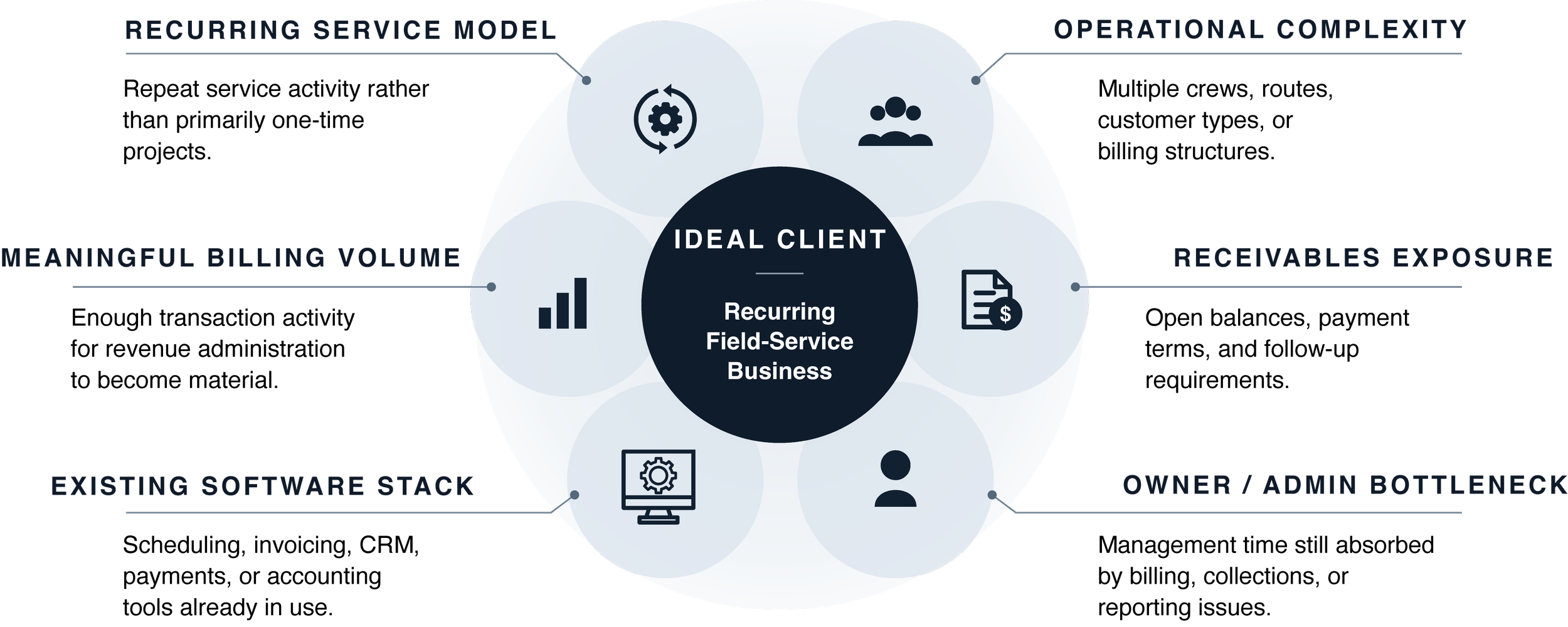
The Client Fit Spectrum
Revenue ranges are initial qualification guidelines. Operational complexity, billing volume, and service requirements ultimately determine suitability.STRONG FIT
$500K – $1M
Recurring field-service businesses with meaningful billing volume, fragmented workflows, receivables exposure, and continued owner involvement.
MODERATE FIT
$1M – $3M
Established businesses with recurring work and administrative complexity, but potentially different internal resources or management requirements.
WEAKER FIT
Under $500K
Very small operators with limited invoice volume, simple billing processes, and minimal need for ongoing revenue administration.
When the Model Makes Sense
When Operational Complexity Outgrows Administrative Capacity.
System Render is particularly relevant when recurring-service activity creates more administrative responsibility than existing personnel and workflows can manage consistently.Common indicators include:Completed work waiting for billing verification or invoicing.Outstanding receivables without consistent follow-up and ownership.Service records, payment information, and reporting spread across disconnected platforms.Owners spending significant time reviewing invoices, resolving discrepancies, or tracking revenue.Existing software that is underutilized or poorly connected across the revenue process.
The objective is not to replace field operations. It is to establish greater control over the revenue processes supporting them.
Is System Render the Right Fit?
Request a Revenue Operations assessment to evaluate your current systems, billing volume, administrative complexity, and alignment with our managed operating model.

Our Partners